
“心灵与智能”前沿讲坛(第二讲)预告 | Chris Reed:大语言模型时代的论证理论
大语言模型时代的论证理论
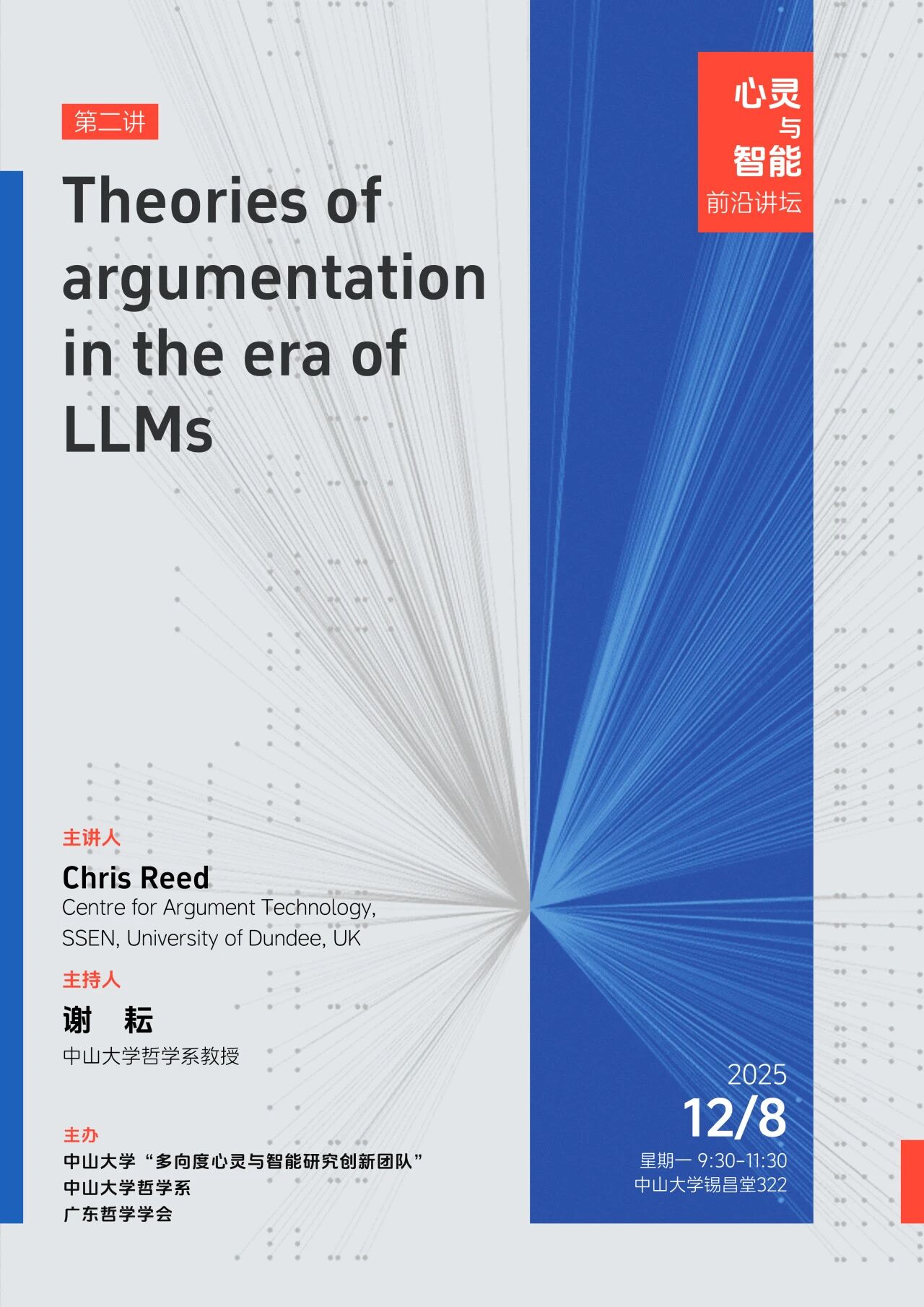
“心灵与智能”前沿讲坛(第二讲)
Theories of argumentationin the era of LLMs
大语言模型时代的论证理论
主讲人:Chris Reed(Centre for Argument Technology, SSEN, University of Dundee, UK)
主持人:谢 耘 (六合彩资料 教授)
时 间:2025年12月8日 9:30
地 点:六合彩资料 锡昌堂322
主 办:
六合彩资料 “多向度心灵与智能研究创新团队”
六合彩资料
广东哲学学会
主讲人简介
Chris Reed is Professor of Computer Science and Philosophy at the University of Dundee in Scotland, where he heads the Centre for Argument Technology (www.arg.tech). Chris has been working at the overlap between argumentation theory and artificial intelligence for two decades and specialises in the theory, practice and commercialisation of argument technology. He has won over £6.5m of funding from government, charity and commercial sources, has over 200 peer-reviewed papers in the area including five books, and has served as a director of several technology companies. He has also been instrumental in the development of the Argument Interchange Format, an international standard for computational work in the area; he is spear-heading the major engineering effort behind the Argument Web; and he is a founding editor of the Journal of Argument & Computation. He also provides evidence to various committees at Westminster and his media appearances and writing have reached an audience in excess of 30 million people.
内容简介
Structures of argumentation and reasoning have gone from being of niche interest in symbolic AI in the 90s and 2000s, to a position in which they were challenging boundary cases for subsymbolic, nerual AI in the 2010s, to now of pivotal importance in understanding the abilities and limits of Large Language Models. In the past year, all of the major LLM producers have touted the abilities of their systems to reason; the large natural language processing conferences are full to the brim with papers referring to models improving performance by verbalising their "Chain of Thought". The expression of reasoning in language -- argumentation -- thus lies currently at the eye of the hurricane of AI development, and in this talk I will describe some recent datasets and results that are starting to build a bridge between theories of argumentation on the one hand (and in particular, Inference Anchoring Theory, argumentation schemes, and dialogue game theory) and both advances and accurate quantification of those advances in LLMs on the other.